‘Free to the People’
I could hear the crunching gravel from the bookmobile’s tires as it pulled into the parking area of our school, Comstock Elementary, in western Minnesota farm country. All of the students in my third and fourth grade classroom started yelling, “It’s bookmobile day!”
Small and compact, the bookmobile had two steps that transported us kids into the stacks, shelves packed floor to ceiling with books that were secured by metal bars so they wouldn’t fall off during a sharp turn or if the librarian hit a pothole.
The bounty of books that the bookmobile held amazed me. There were adventure stories, mysteries, picture books, maps and geography books - something for everyone.
Each time the bookmobile stopped, the driver’s side of the van magically turned into a check-out stand where the librarian would pull out the checkout card, stamp our books and send us on our way with strict due dates reinforced with a smile and encouragement. She’d also offer suggestions. I remember wondering, “Could there be a better job than being in charge of the bookmobile?”
Later, as a full-fledged adult living in Minneapolis after bookmobiles were a part of my past – I loved walking the bridge that crossed the mighty Mississippi to the main downtown library. And today it doesn’t matter if there’s gale-force winds in the spring, my happiness grows with each step as I head out to the downtown Fargo library or across the river to the Moorhead library in Minnesota. Why? Because I know that inside will be a whole new world –books, films, puzzles, and computers - all available for free! Plus sightings of friends or family.
It’s sometimes the sightings of friends or family that has surprised me most. Years ago, my face lit up with joy as I spotted my Uncle Fred in the magazine/newspaper section of the Fargo Library or my Godmother Grace in the same area of the Moorhead Library. It was a chance for an unexpected visit. I sometimes wondered why they were there, but then realized they were frugal and instead of costly magazine or paper subscriptions, they were making use of the free offerings.
Now as I travel, my curiosity gets the best of me and I seek out public libraries as a way to explore architecture and soak in the local culture and history. There’s no better person to ask about a community or city’s lore than a librarian. They’re a terrific source of local information and I always walk away with insider tips and tidbits that can’t be found in the guide books.
One day, noting the beautiful architecture and inscription of one of the Carnegie libraries of early years, I paused. Was the inscription over this one, “Free To the People” really true? Having spent time in the south and aware of the segregation of stores, schools, pools and most public places, I realized that “Free to the People” meant only some people. What I’d taken for granted, both in my youth and very early adulthood, clearly wasn’t always available to all.
Andrew Carnegie, a wealthy Scottish-American industrialist, funded his first of 2500 world-wide libraries in 1883, but he left the policies to be determined by local people. In America, in the south in particular, that meant they were for ‘whites only’. It wasn’t until the civil rights movement in the 1960’s, when segregation laws were struck down, that all public libraries began to integrate.
Now, when I think of integration and libraries I think of it in much broader terms. In addition to opening their doors and welcoming all people, they are opening their shelves to more than just books alone.
Libraries have become ‘Libraries of Things’; with the ability to check out items like tools, nature backpacks, musical instruments, and passes to local museums or parks. There’s no end to the unusual options that are beginning to show up in our public libraries.
For example, the new Moorhead public library/community center, affectionately named The Loop, hasa fabulous feature: a second floor walking loop that circles the building. Through the huge windows, the sky, clouds, trees and the flowing Red River can be seen. One day I watched as a stream of people passed by; a mom and her friend walking side by side, pushing a stroller, an older gentleman lumbering along, a person in a wheelchair, and two teenagers looking so gloriously young and carefree.
Sometimes I still miss the bookmobile of my youth, and though they continue to serve a vital link in rural communities, the libraries of today, like the one in Moorhead, give me renewed hope. Libraries now serve as a kaleidoscope of free knowledge and learning possibilities to all in their communities.
It’s time to visit your local library.
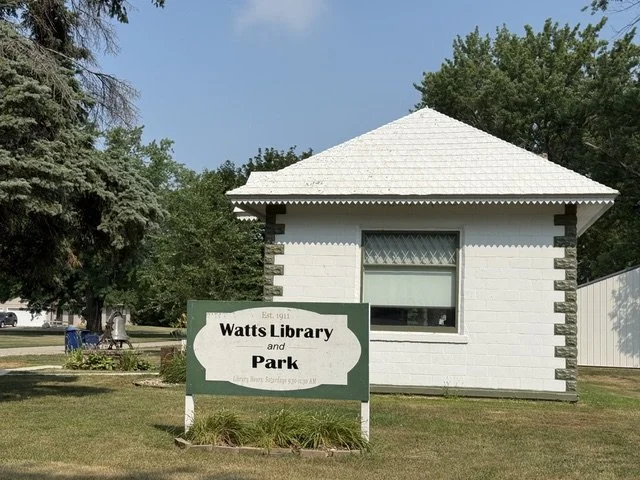
The Watts Free Library in Leonard, ND, population 248. Founded in 1911, it’s known to locals as the Leonard Library.
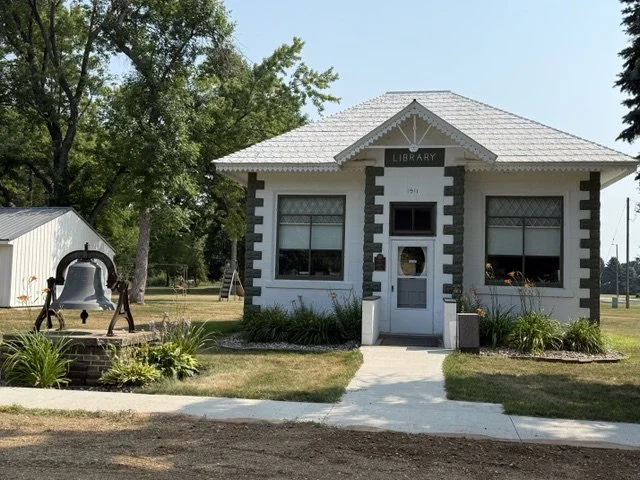
The library was founded by Edgarton Watts, an early homesteader and postmaster, who dedicated the space in memory of his wife Mary Hewitt Watts. It’s listed on the National Register of Historic Places.